
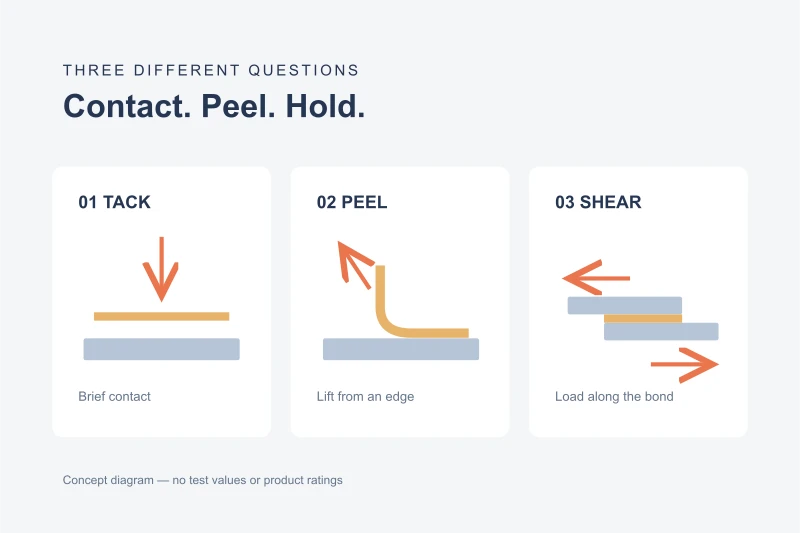
Press a finger into the adhesive: excellent grab. Hang an object: excellent for five minutes. Find it on the floor the next morning: less excellent.
Initial tack describes rapid attachment under brief contact. Peel describes progressive removal from an edge. Shear holding concerns sustained loading parallel to the bond. They are related, but one measurement cannot stand in for the others.
A wall-mounted backplate experiences downward loading. A projecting hook can also pry at its upper edge. Once an edge begins lifting, the remaining bond has more work to do. Adhesive may also creep under sustained load; surviving a quick tug is not a long-term load assessment.
For a useful small-scale comparison, keep substrate, bonded area, preparation, pressure, dwell, and environment consistent. Decide whether you are observing sliding, edge lifting, or removal force. Do not compare different areas on different surfaces and call the result adhesive strength.
A stated load capacity needs its specified conditions. Mirrors, overhead items, and other high-consequence installations require an appropriate mounting system and its complete instructions.
Further reading (technical background, not certification of WINSUFIRE products): 剥离粘接的含义:https://www.tesa.com/en-us/about-tesa/press-insights/stories/what-s-the-deal-with-peel-peel-adhesion-that-is.html 胶接中的常见受力类型:https://www.3m.com.au/3M/en_AU/bonding-and-assembly-au/resources/science-of-adhesion/common-stress-types-adhesive-joints/
Conversation (0)
Be the first to add a useful tip or ask a question.