
Reviewed and updated:
QUICK ANSWER
How do I choose carpet tape?
Measure the available contact width and check both the floor finish and rug backing. Width changes coverage, not roll length or a load rating.
- WINSUFIRE Double-Sided Carpet Tape, 1 in × 16 yd, 1 Roll1 in · 16 yd · 1 rolls · 16 yd total per pack
- WINSUFIRE Double-Sided Carpet Tape, 2 in × 16 yd, 1 Roll2 in · 16 yd · 1 rolls · 16 yd total per pack
Check adhesion and removal in a concealed area before positioning short strips, peeling the liner and pressing.
The first measurement for carpet tape is not the room size. It is the usable contact area beneath the rug. A wider strip has more area per unit length; it does not contain extra length or guarantee a better result on an incompatible floor.
Choose the contact width first
The two listed carpet tapes contain one 16-yard roll per pack, in 1-inch and 2-inch widths. Each is 48 feet long. Check how much continuous, flat backing is available where you intend to apply tape.
A narrow contact zone needs a layout that fits it. A wider zone may accommodate a wider strip, but the floor finish and rug backing still need checking. A width choice is not a load or slip-resistance rating.
Turn a layout into a quantity
Sketch the intended strip positions and add their lengths. For example, four planned strips of 3 feet use 12 feet before cutting allowance. A 48-foot roll provides length for that layout; the example is arithmetic, not a recommendation that four strips suit every rug.
Count corners, changes of direction and any sections that need repositioning. Decide the layout from the rug and installation instructions rather than a universal rule about strips per square foot.
Check both sides of the connection
Identify the floor finish and the rug backing, including coatings or soft layers. The contact surface matters: an adhesive attached to a loose coating is only as dependable as that coating.
Consult the flooring and rug manufacturers’ instructions. Where they prohibit adhesive, choose another suitable arrangement. A rented or delicate finish deserves the same checks as a new one.
Test, position, press and inspect
1. Prepare a small, discreet area as the material and product instructions allow. Keep it clean and dry.
2. Assess both attachment and removal on the actual floor and backing before extending the layout. A sample gives information about those conditions, not a universal removal guarantee.
3. Work with manageable short strips. Attach the first face, retain the remaining liner until positioning, then expose and press the second face as directed.
4. Inspect for folds, lifting edges and movement before use. If the rug shifts or an edge lifts, stop and reconsider the layout and compatibility.
Removing a rug is part of the plan
Plan how the rug will later be lifted before applying the full layout. Do not assume that a product name or a confident first touch guarantees residue-free removal from every finish. If a coating begins to lift, stop rather than pulling harder.
Product images and current specifications
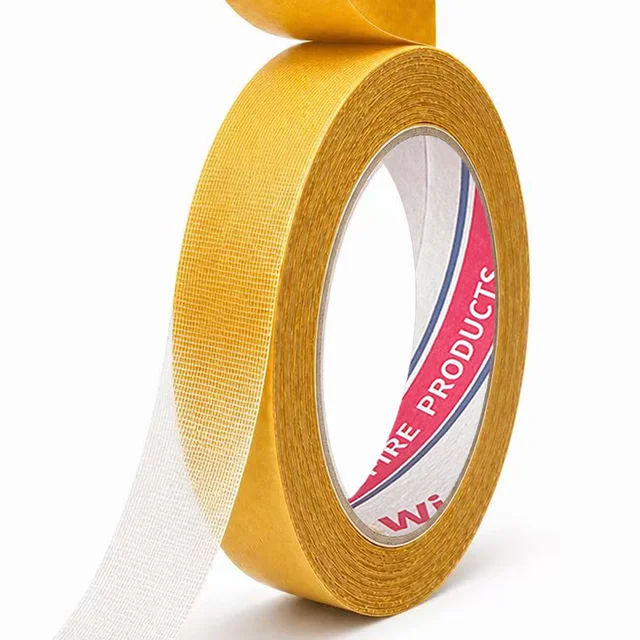
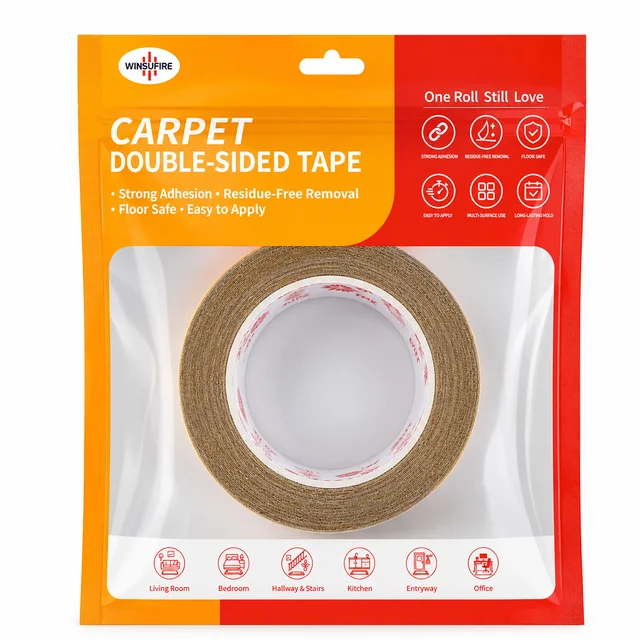
Read from current product records. Images identify appearance and packaging; they are not performance-test evidence. See the product pages for current price and stock.
| Product | Width | Per roll | Rolls per pack | Total per pack |
|---|---|---|---|---|
| WINSUFIRE Double-Sided Carpet Tape, 1 in × 16 yd, 1 Roll | 1 in | 16 yd | 1 | 16 yd |
| WINSUFIRE Double-Sided Carpet Tape, 2 in × 16 yd, 1 Roll | 2 in | 16 yd | 1 | 16 yd |
Questions before you start
Does the 2-inch roll cover twice the length?
No. Both rolls are 16 yards long; the wider roll covers more area per unit length.
Can this page guarantee no damage to wood floors?
No. Finish condition, compatibility, contact time and removal method need product-specific assessment.
Is carpet tape the same as heat-activated seam tape?
No. Confirm the installation method; these double-sided rolls should not be substituted for a specified heat-activated carpet seam system.
Conversation (0)
Be the first to add a useful tip or ask a question.